Signed, But Not Funded
Why the 2026 Budget Betrays the People’s Human Rights Manifesto
Introduction
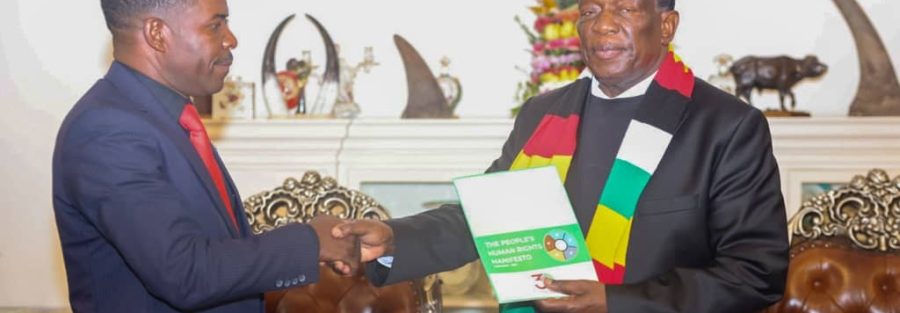
On November 27, 2025, Minister of Finance Mthuli Ncube presented the 2026 National Budget, projecting 5% economic growth. This Policy Brief analyzes the budget through the lens of the People’s Human Rights Manifesto, an accountability tool launched by ZimRights in April 2023 and signed by major political leadership, including President Emmerson Mnangagwa and the Citizen Coalition for Change.
The central finding of this analysis is a critical “Compliance Gap”. While political leaders signed the Manifesto promising to uphold key rights, the 2026 fiscal plan fails to fund them, prioritizing state security over human security and taxation over protection.
Key Findings: The Four Pillars of Non-Compliance
- The “Double Taxation” Trap (Violation of Ask 6: Livelihoods)
- The Problem: The budget maintains a punitive “Double Dip” taxation model where citizens are taxed twice on the same income: first via the Intermediated Money Transfer Tax (IMTT) when receiving money, and second via the Withdrawal Levy when accessing cash.
- Regional Outlier: Zimbabwe stands alone in SADC with this structure; neighbors like Malawi and South Africa have scrapped similar levies to protect financial inclusion.
- Impact: This system punishes the poor for using formal banking, driving them into the informal economy and eroding disposable income by approximately 4.5% before consumption.
- The “Democracy Deficit” (Violation of Ask 9: Independent Institutions)
- The Disparity: There is a shocking imbalance between funding for “Force” versus “Accountability.” The Ministry of Home Affairs (Police) received ZiG 17.2 Billion, while the Zimbabwe Independent Complaints Commission (ZICC)—mandated to investigate police misconduct—received only ZiG 108.1 Million.
Paper Tiger Effect: The ZICC is allocated less than 1% (0.6%) of the Police budget. This financial paralysis prevents the ZICC from
- decentralizing or hiring independent investigators, potentially forcing it to rely on “seconded” police officers to investigate their own colleagues.
- Guns Over Bandages (Violation of Asks 3 & 4: Social Rights)
- Misplaced Priorities: The state allocated ZiG 46.8 Billion (16.1%) to Peace and Security (Defence + Home Affairs), which is nearly 50% more than the ZiG 30.4 Billion (10.5%) allocated to Health.
- Failed Targets: The Health allocation falls significantly short of the 15% Abuja Declaration target. Consequently, public hospitals will continue to face shortages of essential medicines, forcing patients to rely on expensive private pharmacies.
- The VAT Blow (Violation of Ask 6: Livelihoods)
- Regressive Policy: The budget proposes increasing VAT to 5% on January 1, 2026.
- Impact: As a “blind tax” that affects the poor and wealthy equally, this hike disproportionately punishes vulnerable households who spend nearly all their income on consumption, further threatening informal livelihoods.
Key Recommendations
To align the 2026 Budget with the People’s Human Rights Manifesto, ZimRights urges Parliament to:
- Harmonize Transaction Taxes: Zero-rate the IMTT for transactions below the tax-free threshold (approx. USD 500) to ensure survival income is tax-free.
- Implement the “1% for Democracy” Rule: Statutorily ring-fence at least 1% of the National Budget for Independent Commissions, specifically tripling the ZICC allocation to ensure independence.
- Reverse the VAT Hike: Scrap the increase to 15.5% and instead close tax loopholes in the mining sector.
- Reallocate to Health: Reduce the Security vote by 20% and redirect funds to Health & Child Care to meet the 15% Abuja target.
Conclusion
The 2026 Budget serves as a test of the government’s commitment to the Manifesto. Currently, the budget chooses “taxation over protection and guns over bandages,” failing to put its money where its mouth is.